
German business students and Finnish IT students collaborated with sustainability consultant Prof. Dr. Markus Klein at the Co-Innovation Lab in Munich in 2025. Together, they addressed the challenge of inefficient sustainability calculations in gearbox development for small and medium sized enterprises (SMEs). The result is Green Gear, a web-based tool that replaces manual Excel workflows with automated sustainability analysis.
Sustainability Calculation in Gearbox Development
In mechanical engineering and gearbox manufacturing, sustainability calculations are increasingly required throughout the product development process. These calculations typically assess technical components across the three pillars of sustainability: environmental, economic, and social performance. Environmental aspects include CO₂ emissions and material sourcing, economic aspects focus on cost efficiency and lifecycle considerations, while social factors address issues such as labor conditions and supplier responsibility.
As sustainability consultant Prof. Dr. Markus Klein explains: “The decision on where and how to produce a gearbox is mainly driven by economic aspects like material and production costs. Due to EU regulations and public interest, ecological and social sustainability aspects will play a bigger role in future. Therefore, the holistic evaluation of these aspects is key for the decision of long-term investments.”
In practice, Prof. Dr. Markus Klein, sustainability consultant for SMEs, often conducts manual sustainability assessments using extensive Excel spreadsheets. This process requires significant manual data entry and consolidation of data from multiple sources, including gearbox components’ countries of origin, material composition, manufacturing processes, and emission factors. As a result, sustainability calculations are time-consuming, difficult to scale, and prone to inconsistencies.
A typical use case involves evaluating a gearbox during the early design or configuration phase in order to compare design alternatives and identify sustainability trade-offs before production decisions are finalized.
Challenges in Current Sustainability Assessments
By relying solely on manual processes to document and calculate gearbox sustainability, Prof. Dr. Klein faces several challenges. These include the significant time required for manual data entry, limitations in capturing all three pillars of sustainability, and outcomes that lack sufficient depth and consistency. Together, these issues reduce the reliability of the results delivered to clients.
Our Solution: Green Gear – Where Gearbox Manufacturing Meets Clear Sustainability
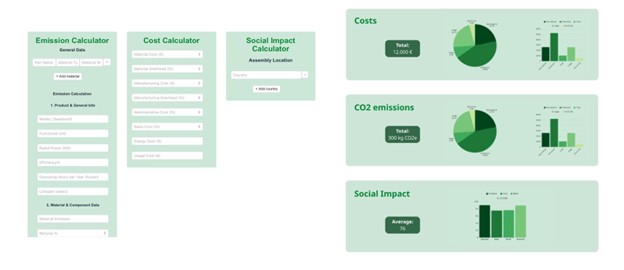
Green Gear is a web application designed to simplify the analysis and documentation of gearbox sustainability metrics. The tool automates the calculation of environmental (CO₂ emissions), economic, and social sustainability efforts as well as economic and social sustainability indicators, significantly reducing manual effort.
Green Gear draws on structured input data provided by users, such as component materials, supplier locations, manufacturing processes, and usage assumptions. These inputs are combined with predefined emission factors, cost parameters, and social risk indicators derived from publicly available databases and industry standards. Users can select and adjust parameters depending on the project context, enhancing both transparency and credibility.
About the Co-Innovation Lab
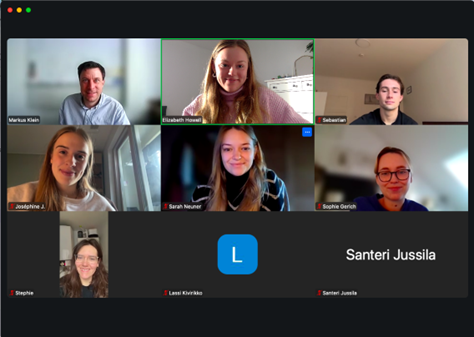
This solution was designed in a project of the Co-Innovation Lab of Hochschule München guided by the lecturers Prof. Jessica Slamka, Prof. Dr. Holger Günzel, Prof. Dr. Lars Brehm, and Mr. Hans-Jürgen Haak together with Anne-Mari Stenbacka and Jere Käpyaho (TAMK). The Co-Innovation Lab offers students a virtual platform for learning how to work as a consulting team by creating temporary partnerships between companies, students, and lecturers.
For more information about the Co-Innovation Lab, contact holger.guenzel@hm.edu or lars.brehm@hm.edu.
- Project results: follows soon