Aclaro: How L1VE Uses Visual Process Mapping to Identify Responsibilities and Reduce Coordination Time

L1VE, a Berlin-based startup specializing in immersive virtual reality streaming, faced a common growth challenge: unclear responsibilities and undocumented processes slowed down operations. To solve this, an international student team developed “Aclaro”: a visual process mapping tool that shows every process step, assigns responsibilities to departments, and connects users directly to the right contact person. The project was conducted during the winter semester 2025 as part of the Co-Innovation Lab, a collaboration between HM Business School and Tampere University of Applied Sciences.

The Challenge of Growing Without Losing Sight

As L1VE expanded its team, processes that once existed informally in people’s heads no longer worked. Without a documented overview, team members spent valuable time figuring out who was responsible for what, leading to redundancies and delays.
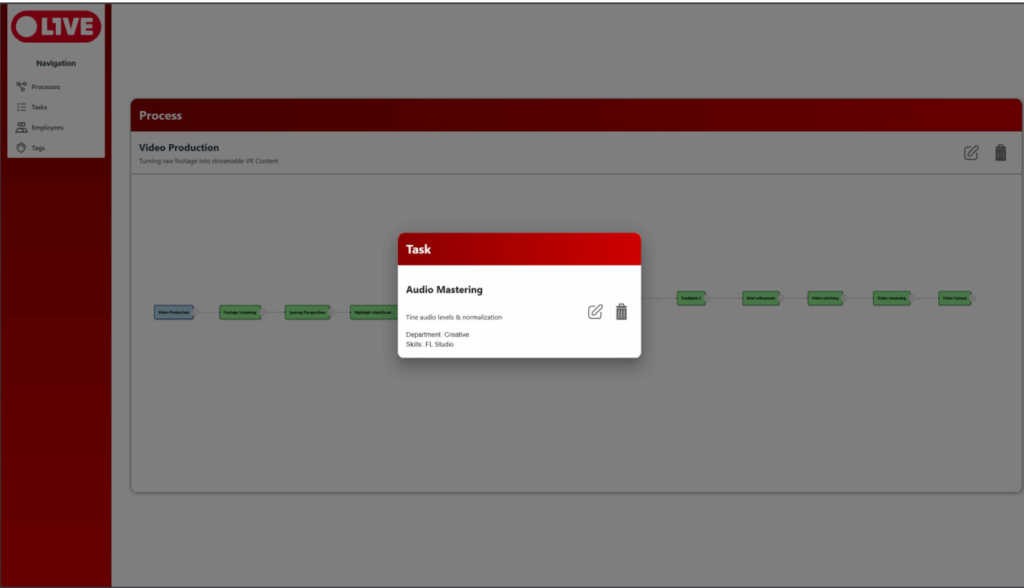
Aclaro Prototype: Process overview with tasks and responsible departments.

Aclaro: More Than a Modeling Tool

Unlike traditional process modeling tools such as BPMN editors, Aclaro is not designed for detailed workflow optimization. Instead, it focuses on one core need: providing a clear, visual overview that answers the question “Who is responsible for this?” The platform allows users to:

  • Map processes visually by defining process steps in an intuitive interface
  • Assign responsibilities by linking each step to a department and tagging required skills
  • Find the right person through an integrated employee database that shows who works in each department
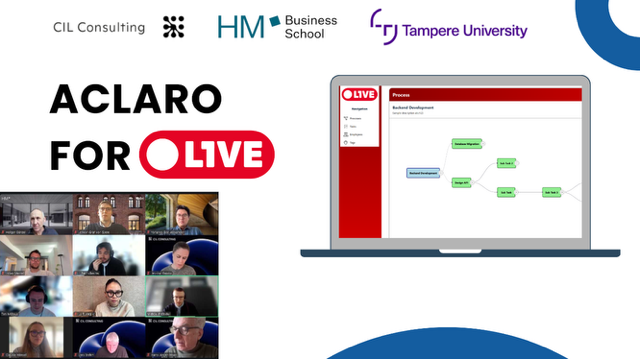
Picctured (l. to r.): Dr. Holger Günzel (lecturer), Joseph v. Spee (Student team), Edo Alexander (Student team), Julian Merkel (CTO & Board Member at L1VE), Lukas Scherzer (Student team), Prof. Dr. Jessica Slamka (lecturer), Tim Möbius (Student team), Le ToungVi (Student team), Michael Pröbstel (Student team), Claudia Hänsel (Student team), Prof. Dr. Lars Brehm  (lecturer), Hans-Jürgen Haak (lecturer) during the final presentation on the 16th of January 2026.

This structure enables leadership to quickly understand the organization’s process landscape and make informed decisions about resource allocation and bottlenecks. For employees and freelancers, it eliminates guesswork. Instead of sending emails to find the right contact, they can look up responsibilities in seconds.

“When we started L1VE, everyone knew everything. But as we grew, that stopped being true. Aclaro gives us back that clarity. Now, instead of asking ‘who handles this?’ five times a day, our team can focus on building amazing VR experiences for our customers.”, says Julian Merkel, CTO & Board Member at L1VE.

About the Co-Innovation Lab

This solution was designed in a project of the Co-Innovation Lab of Hochschule München guided by the lecturers Prof. Jessica Slamka, Prof. Dr. Holger Günzel, Prof. Dr. Lars Brehm, and Mr. Hans-Jürgen Haak together with Anne-Mari Stenbacka and Jere Käpyaho (TAMK). The Co-Innovation Lab offers students a virtual platform for learning how to work as a consulting team by creating temporary partnerships between companies, students, and lecturers.

For more information about the Co-Innovation Lab, contact holger.guenzel@hm.edu or lars.brehm@hm.edu.

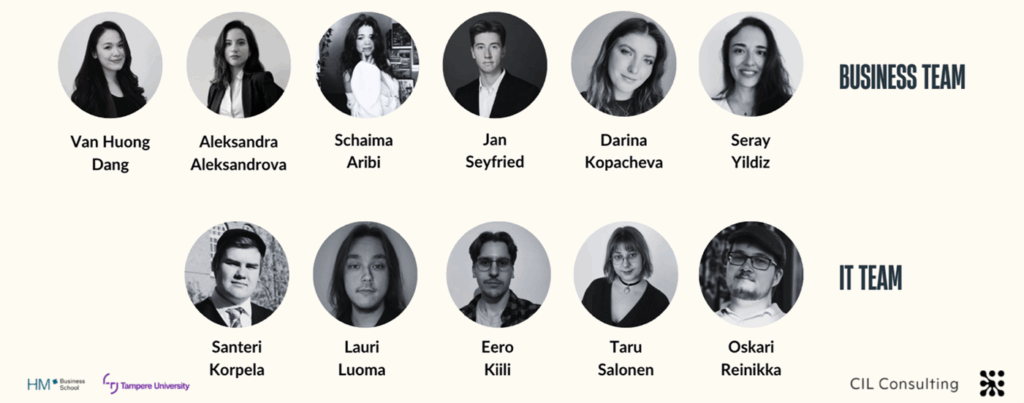
Project Team: Möbius Tim, Tuong Vi Le, Pröbstel Michael, Scherzer Lukas, Henri Nieminen, Spee Joseph, Spira Nitai, Marttila Tuuli, Edo Alexander, Sillanaukee Santeri, Nevalainen Noora, Hänsel Claudia

  • Project results: follows soon

Green Gear: Unlocking Sustainability Results in Gearbox Design

German business students and Finnish IT students collaborated with sustainability consultant Prof. Dr. Markus Klein at the Co-Innovation Lab in Munich in 2025. Together, they addressed the challenge of inefficient sustainability calculations in gearbox development for small and medium sized enterprises (SMEs). The result is Green Gear, a web-based tool that replaces manual Excel workflows with automated sustainability analysis.

Sustainability Calculation in Gearbox Development

In mechanical engineering and gearbox manufacturing, sustainability calculations are increasingly required throughout the product development process. These calculations typically assess technical components across the three pillars of sustainability: environmental, economic, and social performance. Environmental aspects include CO₂ emissions and material sourcing, economic aspects focus on cost efficiency and lifecycle considerations, while social factors address issues such as labor conditions and supplier responsibility.

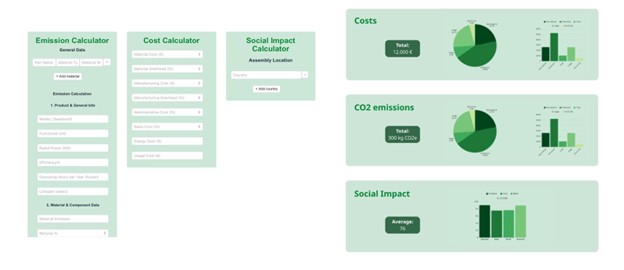
A glimpse into the website, showing input fields and results.

As sustainability consultant Prof. Dr. Markus Klein explains: “The decision on where and how to produce a gearbox is mainly driven by economic aspects like material and production costs. Due to EU regulations and public interest, ecological and social sustainability aspects will play a bigger role in future. Therefore, the holistic evaluation of these aspects is key for the decision of long-term investments.”

In practice, Prof. Dr. Markus Klein, sustainability consultant for SMEs, often conducts manual sustainability assessments using extensive Excel spreadsheets. This process requires significant manual data entry and consolidation of data from multiple sources, including gearbox components’ countries of origin, material composition, manufacturing processes, and emission factors. As a result, sustainability calculations are time-consuming, difficult to scale, and prone to inconsistencies.

A typical use case involves evaluating a gearbox during the early design or configuration phase in order to compare design alternatives and identify sustainability trade-offs before production decisions are finalized.

Challenges in Current Sustainability Assessments

By relying solely on manual processes to document and calculate gearbox sustainability, Prof. Dr. Klein faces several challenges. These include the significant time required for manual data entry, limitations in capturing all three pillars of sustainability, and outcomes that lack sufficient depth and consistency. Together, these issues reduce the reliability of the results delivered to clients.

Our Solution: Green Gear – Where Gearbox Manufacturing Meets Clear Sustainability

Green Gear is a web application designed to simplify the analysis and documentation of gearbox sustainability metrics. The tool automates the calculation of environmental (CO₂ emissions), economic, and social sustainability efforts as well as economic and social sustainability indicators, significantly reducing manual effort.

Green Gear draws on structured input data provided by users, such as component materials, supplier locations, manufacturing processes, and usage assumptions. These inputs are combined with predefined emission factors, cost parameters, and social risk indicators derived from publicly available databases and industry standards. Users can select and adjust parameters depending on the project context, enhancing both transparency and credibility.

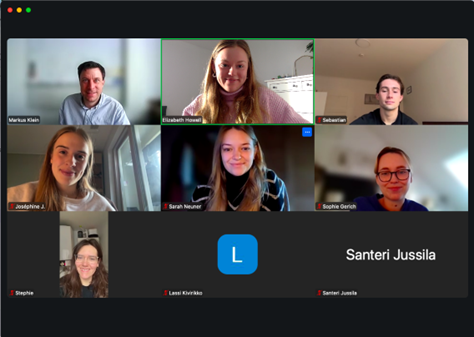
Pictured above is the group of business and IT students including Markus Klein, the client, during weekly Friday meetings. Photo credit: Elizabeth Howell

About the Co-Innovation Lab

This solution was designed in a project of the Co-Innovation Lab of Hochschule München guided by the lecturers Prof. Jessica Slamka, Prof. Dr. Holger Günzel, Prof. Dr. Lars Brehm, and Mr. Hans-Jürgen Haak together with Anne-Mari Stenbacka and Jere Käpyaho (TAMK). The Co-Innovation Lab offers students a virtual platform for learning how to work as a consulting team by creating temporary partnerships between companies, students, and lecturers.

For more information about the Co-Innovation Lab, contact holger.guenzel@hm.edu or lars.brehm@hm.edu.

  • Project results: follows soon

Varala Insight: Smarter Facility Management Through Data

“Varala Insight”, a facility management solution developed by the Co-Innovation Lab team, helps Varala Sports Institute optimize occupancy, reduce energy costs, and improve operational efficiency.

The Challenge: Managing a Busy Campus Without Clear Data Visibility

Varala Sports Institute in Tampere is one of Finland’s leading sports education and training centers, welcoming athletes, students, companies, and visitors year-round. While the institute had access to extensive occupancy and booking data through its CRM/ERP systems, this information was mainly available in reports, tables, and non-visual formats, leaving staff without a clear, intuitive, and visual overview of building occupancy, seasonal demand, or underused facilities.

The lack of visual clarity made analysis time-consuming and pattern recognition difficult. This increased energy and cleaning costs and limited opportunities for targeted sales campaigns or renovations. What was missing was not data itself, but a clear and visual way to turn existing CRM/ERP data into actionable insights.

The Solution: Varala Insight — A Data-Driven Dashboard

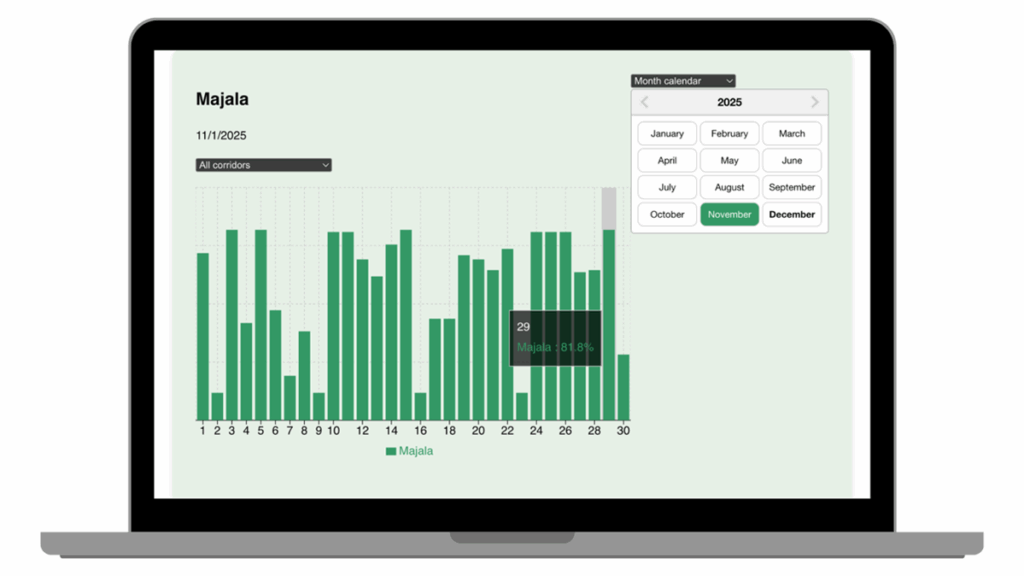
To address these challenges, a student team from the Co-Innovation Lab developed Varala Insight, a web-based dashboard that brings together Varala’s booking and occupancy data into a single view. Valara operational staff can see real-time occupancy across buildings and corridors and switch between daily, weekly, monthly, and yearly views. Sauna usage insights help identify recurring low-usage time slots, supporting targeted campaign planning. Management can export reports with just one click, eliminating the need for time-consuming manual data compilation. Together, these features give Varala a clear, data-driven understanding of how its facilities are used and where efficiency improvements can be made.

Impact: Smarter Operations, Lower Costs, and Greater Sustainability

Varala Insight helps the institute reduce unnecessary heating, optimize cleaning and maintenance, and plan marketing campaigns based on real usage patterns. The result is improved sustainability and lower operational costs. “What impressed us most was how quickly the students translated a real operational challenge into a concrete and visual draft solution.  The demo application provided a clear starting point for developing a solution that suits our operations and builds on our existing CRM/ERP data.” – Petteri Luukkainen (Director of HR, Administration & Development at Varala Sports Institute)

Varala Insight

Collaboration: An International Team Effort

The project was delivered by an international student team from Finland and Germany as part of the Co-Innovation Lab, with six master’s students from Munich University of Applied Science, and five bachelor’s students from Tampere University. The team collaborated closely with Varala’s facility manager throughout the process, ensuring the solution directly supports Varala’s real operational needs.

“Working with an international student team brought new perspectives that we would not necessarily have reached on our own. This collaboration demonstrated how student projects can create genuine value for organizations, not just academic outcomes.” – Petteri Luukkainen

Team Valara with students from Germany and Finland

About the Co-Innovation Lab

This solution was designed in a project of the Co-Innovation Lab of Hochschule München guided by the lecturers Prof. Jessica Slamka, Prof. Dr. Holger Günzel, Prof. Dr. Lars Brehm, and Mr. Hans-Jürgen Haak together with Anne-Mari Stenbacka and Jere Käpyaho (TAMK). The Co-Innovation Lab offers students a virtual platform for learning how to work as a consulting team by creating temporary partnerships between companies, students, and lecturers.

For more information about the Co-Innovation Lab, contact holger.guenzel@hm.edu or lars.brehm@hm.edu.

Author: Van Huong Dang

  • Project results: follows soon

Making Climate Impact Measurable

During the Winter Semester 2025/26, business and IT students developed a digital emissions calculator for industrial wastewater projects as part of the Co-Innovation Lab, in collaboration with EPSE Oy. The project focused on transforming complex, manual CO₂ calculations into a structured and scalable digital solution that supports faster decision-making and reliable climate impact reporting.

A Cleantech Company Addressing Industrial Wastewater Challenges

EPSE Oy is a privately owned cleantech company based in Finland that treats industrial wastewater containing soluble heavy metals. Its patented EPSE™ Method removes a wide range of dissolved metals in a single treatment step, producing clean water and an insoluble multi-metal precipitate that can be reused or safely disposed of.

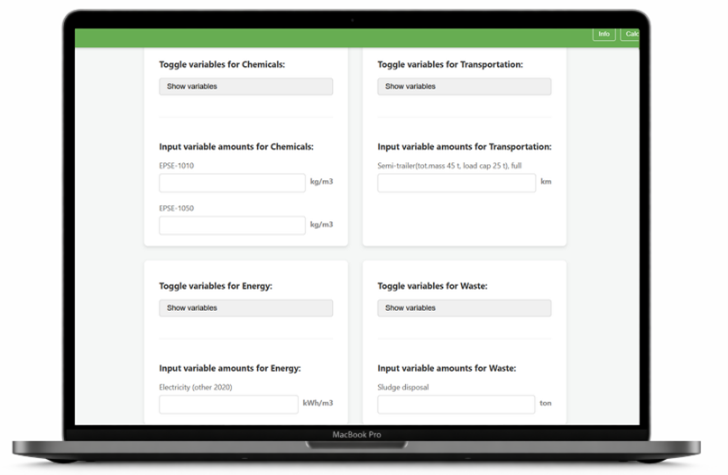
View of the EPSE Calculator Tool: Data Entry Page. Source: epse-calculator

The Challenge: Making Climate Benefits Verifiable

As sustainability requirements increase, EPSE customers request verified CO₂ emissions benefit calculations for wastewater treatment projects during piloting phases. Today, these calculations are not consistently available. In many cases, they are not produced at all, and when they are, technical workers create them manually or with limited support from Excel-based spreadsheets. As a result, calculations are time-consuming, prone to error, and difficult to verify consistently.

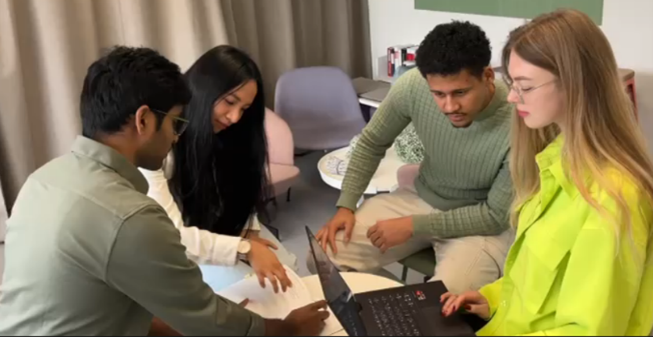
Students: Sai Uttej Surampalli, Maria Necochea, Andre Bickley, Mariia Cherniatina. Photographer: Ali Buyukgoze. Munich, 30 December 2026. Source: Personal Photo. 

The Solution: A Practical Emissions Calculator

To address these challenges, the student team developed a practical emissions calculator tailored to EPSE’s project needs. The tool enables the structured and transparent calculation of CO₂ emission benefits by using pre-given formulas for calculating environmental impacts across pilot projects. EPSE technical team can now select predefined emission sources and enter project-specific quantities. Based on these inputs, the calculator generates a standardized emissions report that can be exported for documentation and customer communication. The underlying database remains adaptable, allowing emission variables, factors, and units to be updated as requirements evolve. By standardizing assumptions, data inputs, and calculation logic, the tool enables EPSE to communicate climate impact consistently across projects. This improves comparability, increases credibility toward customers, and reduces internal coordination effort.  Therefore, the prototype creates a competitive advantage, reduces manual effort, and supports easier communication of climate benefits. This is an improvement EPSE identified as essential when reviewing the solution: “Compared to our previous Excel-based tool, the prototype looks significantly easier to manage and aligns well with our key requirement for a clearer and more structured approach.”- Mikko Rautiainen, EPSE Oy. 

About the Co-Innovation Lab

This solution was designed in a project of the Co-Innovation Lab of Hochschule München guided by the lecturers Prof. Jessica Slamka, Prof. Dr. Holger Günzel, Prof. Dr. Lars Brehm, and Mr. Hans-Jürgen Haak together with Anne-Mari Stenbacka and Jere Käpyaho (TAMK). The Co-Innovation Lab offers students a virtual platform for learning how to work as a consulting team by creating temporary partnerships between companies, students, and lecturers.

For more information about the Co-Innovation Lab, contact holger.guenzel@hm.edu or lars.brehm@hm.edu.

  • Project results:
    • coming soon

LuzVista: Illuminating the Path for Rural Electrification in Bolivia

An interdisciplinary student team from the Munich University of Applied Sciences’ Co-Innovation Lab developed “LuzVista,” a data visualization platform, during the summer semester of 2025. In partnership with the NGO “Luces Nuevas Internacional”, the team created the solution to simplify solar energy data analysis to help authorities and decision-makers make smarter and faster decisions for sustainable energy projects in rural communities in Bolivia.

The Challenge of Turning Data into Light

Developing nations like Bolivia face a major challenge in strategically planning rural electrification. Government authorities and funding bodies depend on clear and compelling data to make sound investment decisions, but this data is often difficult to obtain. This information gap creates a major bottleneck that slows the deployment of sustainable energy and impacts community well-being. This means that many families still rely on candlelight after sunset, making daily activities like schoolwork and household chores as well as life as a whole incredibly difficult.

This reality drives NGOs like Luces Nuevas Internacional, who partner with technology provider Zimpertec to deploy solar home generators in rural areas. While these systems provide valuable operational data for strategic planning, the data itself presented a significant challenge. It was complex and required time-consuming manual transcription into spreadsheets. The fundamental problem was that this static data was not persuasive enough to build a compelling case for action. It was difficult for Luces Nuevas to clearly demonstrate community needs or prove the impact of existing systems to local authorities and decision-makers, which hindered strategic investment.

LuzVista Prototype Screenshots

LuzVista: A Clearer View for a Brighter Future

To tackle this challenge, our student Co-Innovation Lab team developed LuzVista, a user-friendly data platform designed to turn raw data into clear and actionable insights. The platform features a central hub for generator management, data uploads, and an interactive map that links geographical locations directly to performance and usage dashboards.

The solution directly addresses the core pain points of the “As-Is” process by allowing a Luces Nuevas representative to simply upload the raw data files collected from the field. The LuzVista system, powered by a Metabase dashboard, then automatically processes and visualizes the information with easy to interpret graphs and metrics.

“This platform is a valuable tool for us. Its ability to create a clear visual presentation and highlight key diagnostics helps us analyze and present our results much faster. By improving our tools this way, we increase the value of the strategic discussion about achieving Universal Access to Energy in Bolivia.” said Roberto Ayala of Luces Nuevas Internacional.

(Mr. Ayala’s responses were consolidated and edited for clarity and length.)

By automating data analytics, LuzVista gives Luces Nuevas the power to build a compelling, data-driven case for rural electrification. The platform provides the clear, visual evidence needed to gain support from decision-makers, accelerate strategic decisions, and secure the funding to bring sustainable energy to the families who need it most.

LuzVista Prototype Screenshots
The Co-Innovation Lab Project Team meets with two Luces Nuevas representatives in front of the University of Applied Sciences Lothstraße Campus. Pictured (l. to r.): Jason White, Konul Baghirova, Yalnaz Baig, Alexander Kluge, Illia Spasonov, Magnus Potter, Ronald Cavero (Luces Nuevas), Roberto Ayala (Luces Nuevas). Not pictured: Jan Funk (Co-Innovation Lab Project Team). – Source: Personal photo

About the Co-Innovation Lab

This solution was designed in a project of the Co-Innovation Lab of Hochschule München guided by the lecturers Prof. Dr. Holger Günzel, Prof. Dr. Lars Brehm, Prof. Dr. Markus Thimmel, Prof. Dr. Johannes Ebke and Mr. Hans-Jürgen Haak. The Co-Innovation Lab offers students a virtual platform for learning how to work as a consulting team by creating temporary partnerships between companies, students, and lecturers.

For more information about the Co-Innovation Lab, contact holger.guenzel@hm.edu or lars.brehm@hm.edu.

  • Project results:
  • Project Team: LuzVista

Turning Climate Goals into Local Action

An international group of business and IT students partnered with LocalZero to create a platform that bridges the gap between local climate action and proven climate strategies. The goal: to help communities across Germany implement effective measures for achieving climate neutrality. This requires a tool that aligns efforts and amplifies impact

Who is LocalZero?

LocalZero is a non-profit organization committed to helping cities across Germany achieve climate neutrality by 2035. It works with voluntary teams in cities who implement targeted climate actions, known as “local measures”. These measures are based on a set of scientifically developed “top measures” that provide a framework for addressing key areas such as energy, mobility, and waste management.

In their mission to combat climate change, the voluntary teams collaborate closely with municipalities. However, because local measures are often named and categorized differently from the top measures, this creates challenges in implementation and progress tracking.

The Challenges Faced by LocalZero

Several key challenges were identified in the development of this solution. The lack of clear connections between local and top measures was highlighted, resulting in reduced transparency within the overall climate strategy. This lack of clarity made it more difficult for teams to effectively demonstrate their impact. Difficulties were also encountered by voluntary teams in communicating their progress to key stakeholders, including policymakers, as well as in collaborating with other cities. Additionally, the process of comparing progress across cities was made challenging, which restricted the sharing of best practices and limited the scalability of successful projects.

The Solution: A Unified Platform for Local Climate Action

With this platform, LocalZero’s voluntary teams will be better equipped to implement effective measures, track their progress, and demonstrate their impact to stakeholders. This unified approach not only accelerates local climate action, but also strengthens the connection between community efforts and national climate goals.

On the left is an overview of all the top measures in the selected energy sector. By hovering over the city icon, a quick preview appears of all the cities that are currently working on this measure. By clicking on the arrow on the top measure “Funding programs for PV systems”, you get to the detailed description of the chosen top measure and corresponding best practice, pictured on the right.

Pictured above is our regular sprint review via Zoom involving the client Leon Beck (Project Manager at LocalZero) and our student team. Photo credit: Lea Langendörfer.

Scrolling down, all the local measures are listed by cities. By clicking on the links, you get to the description of each local measure. In this example, the city Bad Hersfeld is implementing the local measure “Municipal PV funding”.

About the Co-Innovation Lab

This solution was designed in a project of the Co-Innovation Lab of Hochschule München guided by the lecturers Prof. Dr. Holger Günzel, Prof. Dr. Lars Brehm, Prof. Dr. Jessica Slamka, Mr. Hans-Jürgen Haak, Ms. Anne Mari Stenbacka and Mr. Jere Käpyaho. The Co-Innovation Lab offers students a virtual platform for learning how to work as a consulting team by creating temporary partnerships between companies, students, and lecturers.

For more information about the Co-Innovation Lab, contact holger.guenzel@hm.edu or lars.brehm@hm.edu.

  • Project results:
  • Project Team: LocalZero

HM Sense Collab: Empowering Research, Teaching and Collaboration Through Accessible Sensor Data

Hochschule München (HM) is pushing the boundaries of digital transformation with HM Sense Collab, an innovative platform designed to simplify and enhance the use of sensor data collected and stored by the previously existing HM-Sense sensors across the University buildings and faculties for students, researchers and Facility Management. By providing easy, log-in based access without intermediaries, intuitive tools for analyzing, visualizing and exporting real-time data, HM Sense Collab fosters collaboration across disciplines and opens new doors for practical learning and research.

What Does HM Sense Collab Do? The platform processes and displays real-time data from sensors located across University facilities. Variables such as temperature, light intensity, humidity and CO₂ levels are displayed on user-friendly dashboards. These dashboards are tailored for specific user groups—students, researchers and administrators—to ensure ease of access and relevance.

The data can be utilized for different academic and administrative purposes. For example, a Physics student could analyze CO₂ patterns to understand indoor air quality, while a facility administrator might monitor temperature data to optimize energy usage in classrooms. Additionally, the data is exportable in formats like CSV, enabling further analysis and integration into reports or presentations.

Collaborative Innovation 

The development of HM Sense Collab was a joint effort involving Bachelor and Master students from HM and IT students from Tampere University of Applied Sciences in Finland. Dr. Holger Günzel, Dr. Lars Brehm, Dr. Johannes Ebke, Hans-Jürgen Haak, Anne-Mari Stenbacks and Jere Käpyaho, alongside the Digital Transformation Lab (DT.Lab) and Co-Innovation Lab, guided this diverse team in developing the platform.

Emine Baspinar, a Bachelor student from the Business Administration program at HM, noted: “It was incredible to work with Master students and international peers from Finland. The collaboration taught me so much about teamwork and cross-cultural problem-solving.”

Real-World Impact 

HM Sense Collab demonstrates its versatility by serving various educational and research goals. By providing direct access to the HM Sense sensor data, students gain hands-on experience working with real-world datasets during their classes, preparing them for careers in data analytics and other cutting-edge fields. Researchers benefit from centralized, easily accessible data for interdisciplinary studies in sustainability and energy consumption optimization, while administrators can optimize campus resource usage in terms of heating, illumination and ventilation to save costs and reduce the environmental impact.

The platform’s usability aligns with our client’s vision, Johannes Ebke, professor of Informatics at HM. As he emphasized, “HM Sense Collab makes data accessible and usable for everyone, regardless of their expertise. It’s about breaking barriers and enabling impactful insights.”

Technical Foundation 

HM Sense Collab is built on a robust cloud-based infrastructure using open-source technologies like Python, HTML, CSS and JavaScript and is hosted on an AWS Beanstalk Cloud service. This ensures flexibility, scalability, rapid access and secure real-time processing of sensor data.

About the Co-Innovation Lab

This solution was designed in a project of the Co-Innovation Lab of Hochschule München guided by the lecturers Prof. Dr. Holger Günzel, Prof. Dr. Lars Brehm, Prof. Dr. Jessica Slamka, Mr. Hans-Jürgen Haak, Ms. Anne Mari Stenbacka and Mr. Jere Käpyaho. The Co-Innovation Lab offers students a virtual platform for learning how to work as a consulting team by creating temporary partnerships between companies, students, and lecturers.

For more information about the Co-Innovation Lab, contact holger.guenzel@hm.edu or lars.brehm@hm.edu.

  • Project results:
  • Project team: Roxana Vlasie, Ana Guisao, Vanessa López, Zain Rizvi, Farah Naouar, Valentin Schmid, Emine Baspinar, Juho Viskari, Juho Yli-Rajala, Noel Tulirinta, Matti Hakola, Heini Talio

OBSTPLAN: Empowering Landowners to Create Orchard Meadows and Boost Biodiversity

Meadow orchards, traditional ecosystems rich in biodiversity, are biodiverse landscapes, where widely spaced fruit trees are combined with natural grasses and wildflowers, creating a habitat that supports wildlife while producing food. These traditional ecosystems are rich in biodiversity and preserve the cultural and ecological heritage of regions like Bavaria. Yet, these orchards have been in significant decline due to urbanization and economic pressures. OBSTPLAN addresses this pressing challenge by offering a simple, user-friendly solution to help landowners and communities restore these valuable landscapes.

Bavaria has lost approximately 60% of its meadow orchards in recent decades. These natural habitats, vital for countless insects, birds, and other wildlife, have been replaced by industrial agriculture and urban development. As meadow orchards vanish, so too does the biodiversity they support. Despite available land and resources, many potential orchard developers lack the knowledge or tools needed to plan and maintain these ecosystems effectively. Furthermore, relevant information is often scattered across numerous websites and, in some cases, remains insufficiently digitized.

OBSTPLAN is here to bridge that gap. Designed as an centralized and intuitive digital platform, it empowers users to:

  • Plan and manage meadow orchards tailored to their specific land conditions.
  • Access localized recommendations for fruit tree varieties.
  • Learn about subsidies and funding opportunities to support their efforts.
Color-coded map and recommended apple tree varieties

As one early user noted, “OBSTPLAN makes it easy to transform unused land into vibrant ecosystems that benefit both the environment and the community.”

Traditional meadow orchards, once common in Bavaria, are more than just agricultural spaces. The loss of these orchards, driven by economic and urban pressures, has reduced biodiversity and led to the extinction of many native fruit varieties.

To combat this, OBSTPLAN integrates technology and ecological expertise, providing actionable guidance for restoring these vital landscapes. With its interactive features, OBSTPLAN simplifies decision-making, allowing users to:

  • Evaluate their land’s potential for orchard development.
  • Select optimal tree varieties based on soil quality and other factors.
  • Navigate the often-complicated funding landscape.

Users can view color-coded maps that recommend suitable apple tree varieties based on soil conditions and regional factors. Green indicates that the soil is excellent for the apple variety, yellow indicates a mixed soil type where the apple could also be planted, and red suggests avoiding planting the variety in that soil. These insights ensure that users can optimize their efforts for both productivity and biodiversity.

OBSTPLAN is designed for beginners and experts alike. It plans to expand its offerings with educational workshops and community initiatives, fostering a culture of environmental stewardship.

In collaboration with the Rotary Club Neuburg an der Donau, OBSTPLAN promotes sustainable agriculture and biodiversity. The platform’s user-friendly interface and practical features save time and reduce barriers for farmers, landowners, and community groups, enabling them to contribute to a greener Bavaria.

Team and client Holger Pilgenröther (Rotary Neuburg)

OBSTPLAN’s initial focus is on Bavarian landscapes, particularly around Neuburg an der Donau. By providing localized solutions, it addresses specific regional needs while setting the stage for broader applications. Supported by the Rotary Club, OBSTPLAN aims to expand its reach, empowering communities across Germany to restore biodiversity and cultivate sustainable landscapes.
The success of OBSTPLAN demonstrates the power of collaboration between academia, industry, and community organizations. Developed by students from the University of Applied Sciences Munich (HM) and Tampere University of Applied Sciences (TAMK), OBSTPLAN is a shining example of innovation in action.
With OBSTPLAN, the future of Bavaria’s meadow orchards is in your hands. Transform underused land into thriving ecosystems and play a role in preserving biodiversity for generations to come. Together, we can cultivate a greener, more sustainable future.

.

About the Co-Innovation Lab

This solution was designed in a project of the Co-Innovation Lab of Hochschule München guided by the lecturers Prof. Dr. Holger Günzel, Prof. Dr. Lars Brehm, Prof. Dr. Jessica Slamka, Mr. Hans-Jürgen Haak, Ms. Anne Mari Stenbacka and Mr. Jere Käpyaho. The Co-Innovation Lab offers students a virtual platform for learning how to work as a consulting team by creating temporary partnerships between companies, students, and lecturers.

For more information about the Co-Innovation Lab, contact holger.guenzel@hm.edu or lars.brehm@hm.edu.

  • Project results:

EnerWeave: Finding the perfect system for you to optimize energy consumption

Students develop a new application to match a unique set of energy devices with the perfect system to combine them, centralizing energy management and optimizing consumption.

As more homeowners transition to smart homes, the demand for effective Home Energy Management Systems (HEMS) has grown significantly. HEMS combine all energy devices, providing a unified energy overview and enabling centralized optimization of energy consumption. However, finding the perfect HEMS that connects individual devices can be complex and time consuming often accompanied by an overwhelming influx of information.

To tackle this challenge, the Co-Innovation Lab, which brings together students from Munich University of Applied Sciences and Tampere University of Applied Sciences, has developed EnerWeave together with SPINE GmbH, a Munich-based clean energy technology start-up. EnerWeave is a user-friendly application that recommends the optimal HEMS based on a household’s individual energy setup.

The application could be launched by SPiNE GmbH. Keep an eye out and give it a try!

The idea was to make it easy for the user to transition to sustainable and cost-effective energy management. By simply selecting the hardware from the list of devices provided, EnerWeave creates a customized overview of the home’s energy setup. It then analyzes this setup and provides real-time recommendations for the most suitable HEMS, highlighting key features and offering a direct link to the recommended system. EnerWeave ensures that the recommended HEMS is compatible with the devices the user already owns, while also helping them plan future hardware purchases based on the supported HEMS ecosystem.

By simply selecting devices from the list, the individual setup can be created for analysis.

“EnerWeave is a great tool for closing the information-gap between HEMS providers and customers / installers in search of a suitable HEMS. The Co-innovation lab has helped us to rapidly design and develop the application. SPiNE is definitely planning to launch and extend this as a product in the near future.” – Cooperation Partner, Dr. Martin Stötzel

EnearWeave was developed in collaboration with 11 students from different countries including Germany, Finland, Czech Republic, India and Mexico. With different academic backgrounds including Business Administration, Digital Technology Management and Computer Science, the students managed to create a high-quality software that matches the vision of SPiNE.

The team (names from left to right and top to bottom): Lilian Gnann, Angelica Bravo, Pranav Deep, Krutika Konwar, Terezie Rajtarova, Anna Kulovuori, Jonna Kyllönen, Sebastian Stumpf, Mikko Pasanen, Aleksi Väätäinen, Otto Melentjeff

The students worked closely with SPiNE’s founders and partners. Direct and regular feedback ensured that the project was adapted to the needs and requirements of the start-up.

About the Co-Innovation Lab

This solution was designed in a project of the Co-Innovation Lab of Hochschule München guided by the lecturers Prof. Dr. Holger Günzel, Prof. Dr. Lars Brehm, Prof. Dr. Jessica Slamka, Mr. Hans-Jürgen Haak, Ms. Anne Mari Stenbacka and Mr. Jere Käpyaho. The Co-Innovation Lab offers students a virtual platform for learning how to work as a consulting team by creating temporary partnerships between companies, students, and lecturers.

For more information about the Co-Innovation Lab, contact holger.guenzel@hm.edu or lars.brehm@hm.edu.

  • Project results:

Intellegam EcoLLytics: Revolutionizing User and Sustainability Analytics for LLMs usage

Modern businesses increasingly rely on LLMs for various applications, but the environmental
impact and user engagement metrics often remain underexplored due to insufficient analytical tools. Co-Innovation Lab at Hochschule München, in collaboration with Intellegam GmbH, a Munich-based high-tech company, has developed EcoLLytics, a solution designed to merge environmental insights with user engagement analytics for using LLM technology.

Project team HM (Anna-Lena Feckl, Marius Thoma, Marco Zöller, Philipp Seiter, Mahsa Iraniara, Andriy Vershynin, Herdiana Ramadhani, and Kevin Manlik)

EcoLLytics: A Unified Approach to Analytics

EcoLLytics is a user-friendly dashboard developed at Co-Innovation Lab at the Hochschule München. An interdisciplinary team of eight students from various fields, including business administration and computer science, collaborated to create this innovative solution. The dashboard not only tracks energy consumption from using LLM technology but also provides detailed insights into user interactions with the LLM.

Marc Gehring, CTO of Intellegam GmbH, emphasizes, “EcoLLytics bridges a crucial gap by integrating sustainability metrics with user engagement analytics, providing a unified dashboard that offers real-time insights and comprehensive monthly reports for LLM usage.

The EcoLLytics dashboard provides actionable insights, such as identifying high energy consumption periods, optimizing model usage, and recommending optimal utilization of LLMs to  reduce energy costs and environmental impact. Here are the Key Features of Intellegam EcoLLytics:

User Engagement Analysis: Detailed metrics on user engagement, including daily usage by month, hourly usage by day, and sentiment analysis to track and understand user behaviour and satisfaction levels.

Sustainability Performance: Real-time data on energy consumption per week and cost statistics, providing insights into total energy consumption, daily costs, and CO2 emissions to enhance sustainability efforts.

Operational Efficiency: Monitoring system uptime, success rates of sessions, and model usage distribution to optimize resource allocation and improve overall system performance.

Technical Health: Insights into session durations, average latency, and system response times to quickly identify and address performance bottlenecks and ensure efficient system operations.

Dialog Analysis: Analysis of most asked questions and searched topics to improve user support and tailor content based on common queries and user interests.

Executive Summary: Comprehensive overview of user engagement, sentiment analysis, and model usage, offering actionable insights and data-driven recommendations to enhance user satisfaction, optimize model performance, and align operations with organizational goals.

Using EcoLLytics is straightforward. Companies can integrate their data sources into the dashboard, which then visualizes the data in an intuitive interface. The dashboard offers personalized insights and actionable recommendations, empowering businesses to optimize their operations and reduce their environmental footprint.

The Team

The development of EcoLLytics was a collaborative effort involving students from various academic backgrounds, guided by experienced instructors, including Prof. Dr. Lars Brehm, Prof. Dr. Johannes Ebke, Prof. Dr. Holger Günzel, Prof. Dr. Markus Thimmel, and Hans-Jürgen Haak. This collaboration ensured the project met industry needs, combining academic knowledge with practical application.

About the Co-Innovation Lab

This solution was designed in a project of the Co-Innovation Lab of Hochschule München guided by the lecturers Prof. Dr. Holger Günzel, Prof. Dr. Lars Brehm, Prof. Dr. Markus Thimmel, Prof. Dr. Johannes Ebke, and Hans-Jürgen Haak. The Co-Innovation Lab offers students a virtual platform for learning how to work as a consulting team by creating temporary partnerships between companies, students, and lecturers.

For more information about the Co-Innovation Lab, contact holger.guenzel@hm.edu or lars.brehm@hm.edu.

Team: EcoLLytics